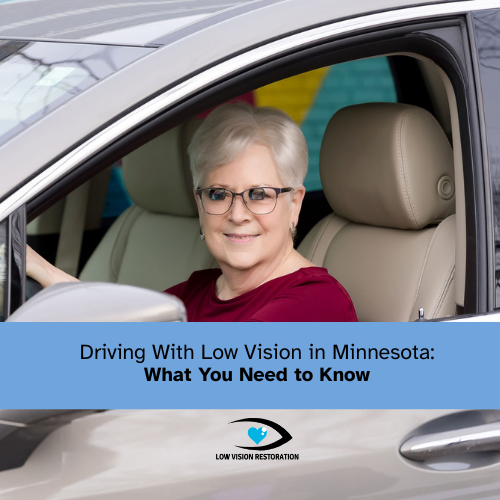
For many people, driving represents independence, connection, and quality of life. If you have permanent vision loss or low vision, understanding Minnesota’s driving vision requirements is an important step in knowing what options may still be available to you.
At Low Vision Restoration, Dr. Palmer works with patients who want clear, accurate guidance about driving eligibility, vision standards, and whether the specialized low vision solutions that we offer may help support safe driving.
Minnesota Vision Requirements for Driving
Minnesota requires all drivers to meet minimum vision standards to ensure safety on the road. Vision is evaluated based on:
- Visual acuity, or how clearly you can see
- Visual field, or how wide an area you can see while looking straight ahead
If your vision does not meet the standard for an unrestricted driver’s license, this does not automatically mean you cannot drive. In many cases, drivers may qualify to drive with restrictions or require further evaluation.
When Additional Vision Evaluation Is Required
A full eye examination may be required if:
- Vision screening results fall below standard levels
- There is a concern about reduced peripheral vision
- Double vision is present
- Vision cannot be accurately measured during screening
- A medical provider, court, or licensing authority requests further review
Eye examinations used for licensing must be completed by a licensed eye care professional, and submitted within the required time frame.
Restricted Licenses and Low Vision
Minnesota allows for restricted driver’s licenses when vision falls within certain ranges. Restrictions may include:
- Daylight-only driving
- Speed limitations
- Geographic driving limits
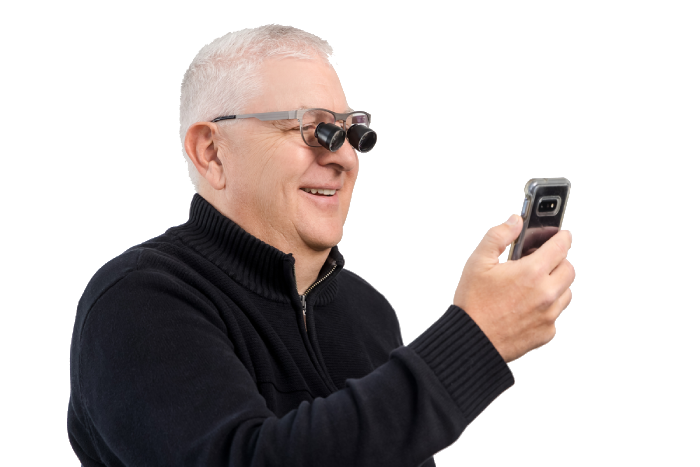
- Required use of corrective lenses or adaptive equipment (like bioptic telescope glasses)
- Additional mirrors or safety modifications
These restrictions are designed to balance public safety with a person’s ability to remain independent.
How Low Vision Care Can Help
Low vision care focuses on helping you make the most of the vision you still have. At Low Vision Restoration, Dr. Palmer evaluates and demonstrates whether custom glasses could support driving-related goals.
This can include:
- Assessing functional vision related to driving tasks
- Prescribing custom low vision glasses
- Helping complete vision documentation accurately and fairly
- Explaining state requirements in clear, understandable terms
Low vision care does not override state law, but it can help determine whether adaptive glasses are appropriate and whether further evaluation is warranted.
Every Case Is Individual
Driving eligibility is never one-size-fits-all. Vision levels, eye conditions, and functional ability vary from person to person. That is why individualized evaluation is essential.
If you have been told “nothing more can be done,” or if you are unsure how vision changes affect your driving options, a low vision consultation can provide clarity.
Schedule a Low Vision Consultation
If vision changes are affecting your confidence or independence behind the wheel, Low Vision Restoration is here to help. Dr. Palmer provides patient-centered evaluations focused on safety, function, and quality of life.
Contact our office to schedule a free low vision telephone consultation and learn more about your options.
Call 612-729-3030 or visit LowVisionOfMN.com. Serving the Twin Cities metro and Greater Minnesota.
Citation
This content is based on official Minnesota driver vision standards and guidance published by the Minnesota Legislature and Department of Public Safety.
Source: Minnesota Driver Vision and Licensing Guidelines
https://www.leg.mn.gov/docs/2015/other/150439.pdf