Answers from Dr. Chris Palmer, Low Vision Restoration
If you’ve recently been told there’s nothing more that can be done for your vision, you’re not alone. Many people are surprised to learn that low vision care is a specialized area of optometry focused on helping people make the most of the vision they still have.
Below are answers to some of the questions I hear most often from people and families seeking low vision care in Minnesota.
What Is Low Vision?
Low vision is vision that is not good enough to do the things you want or need to do, even after using regular glasses, contact lenses, medication, or surgery.
Many people with low vision struggle with everyday tasks such as:
- Reading books, mail, or medication labels
- Using a computer, tablet, or smartphone
- Watching television
- Recognizing faces
- Enjoying hobbies like sewing, woodworking, or crafts
- Seeing signs or menus
The good news is that low vision does not always mean complete blindness. Many people still have usable vision that can often be enhanced with specialized low vision devices and customized optical solutions.
What Causes Low Vision?
As a low vision doctor, I’m often less concerned about the specific diagnosis than how your remaining vision affects your daily life. My goal is to help you accomplish the tasks that matter most to you.
That said, many of our patients have vision loss caused by conditions such as:
- Age-related macular degeneration (AMD)
- Stargardt disease
- Glaucoma
- Ocular albinism
- Retinitis pigmentosa
- Diabetic retinopathy
- Stroke-related hemianopsia
- Rod-cone dystrophy
This is not a complete list. If you have usable vision and are struggling with everyday activities, you may benefit from a low vision evaluation regardless of the underlying condition.
How Is a Low Vision Exam Different From a Regular Eye Exam?
A low vision evaluation is very different from your routine eye appointment.
Rather than focusing primarily on eye health, a low vision evaluation focuses on improving your ability to perform everyday activities.
Your visit typically lasts about an hour and includes:
- A conversation about how vision loss is affecting your daily life
- Discussion of your goals and the tasks you want to accomplish
- Careful testing to determine whether updated glasses may help
- Evaluation of specialized magnification systems
- Testing different lighting conditions
- Demonstration of optical and electronic low vision devices
During your appointment, you’ll actually try different devices while performing the activities that are important to you.
How Is a Low Vision Doctor Different From My Other Eye Doctors?
Your comprehensive eye doctor focuses on diagnosing and treating eye diseases and preserving your eye health.
A low vision doctor has additional training in specialized optics, magnification systems, custom low vision glasses, electronic devices, lighting, and vision rehabilitation strategies.
Just as importantly, we spend the time needed to understand how your vision affects your everyday life.
Rather than simply measuring eyesight, we analyze how your remaining vision can be used more effectively. We look at factors such as:
- Working distance
- Magnification needs
- Lighting
- Field of view
- Depth of focus
- The specific tasks you want to accomplish
Our goal is to help people regain independence whenever possible.
Do Vitamins Help Low Vision?
Certain nutritional supplements may help slow the progression of some eye diseases.
Large clinical studies, including the AREDS and AREDS2 trials from the National Eye Institute, have shown that specific vitamin formulations can help reduce the progression of certain forms of age-related macular degeneration.
Other research has also shown benefits from nutrients such as lutein, zeaxanthin, and omega-3 fatty acids for some people.
However, not every eye condition responds to supplements. Before starting any vitamins, it’s important to discuss your specific diagnosis with your eye care provider.
What Is the Free Telephone Consultation?
Not everyone is a good candidate for low vision rehabilitation.
That’s why I offer a complimentary telephone consultation before scheduling an appointment.
During this conversation, we’ll discuss:
- Your vision
- Your current eye condition
- The activities you’re struggling with
- Your goals
- Your general health and mobility
This allows us to determine whether low vision services are likely to help before you spend time and money coming into the office.
How Do I Know the Glasses Will Help?
One of the biggest concerns people have is whether specialized low vision glasses will actually make a difference.
During your evaluation, you’ll have the opportunity to try the glasses before anything is prescribed.
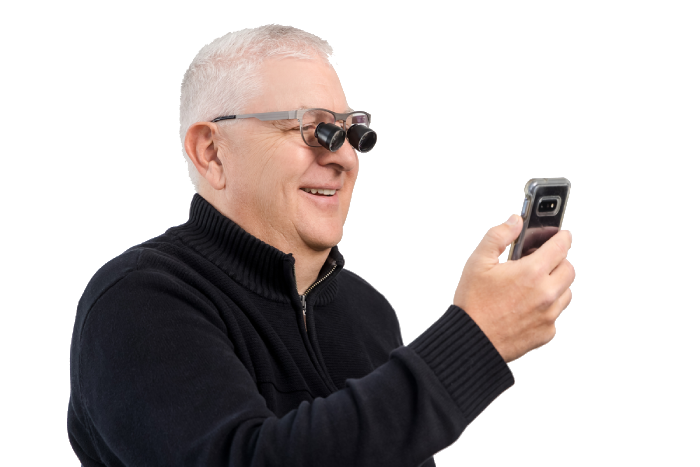
You’ll test customized telescopic glasses, microscope glasses, prism systems, or other magnification devices while performing the activities you want to improve.
We don’t order customized low vision glasses until you can see that they work for you.
What If My Vision Changes After I Get My Glasses?
Vision can change over time, especially with progressive eye diseases.
If that happens, we’ll first recommend that you visit your regular eye doctor to determine whether there’s a medical reason for the change.
If the change is permanent and affects your ability to function, we can often modify the magnification or prescription of your low vision devices without replacing everything.
During the first year, these adjustments are typically made at no additional charge.
What Happens During a Low Vision Evaluation?
Your appointment begins with a conversation about your vision challenges and the activities you’d like to do more easily.
You may be asked to bring examples of tasks that are difficult, such as:
- Reading your mail
- Using your laptop or smartphone
- Crossword puzzles
- Sewing or quilting
- Crafts and hobbies
- Music or sheet music
- Other daily activities that matter to you
We’ll perform specialized vision testing and demonstrate customized optical devices designed specifically for your needs.
If a solution improves your ability to perform those tasks, we’ll create a personalized treatment plan to help you maintain your independence and quality of life.
Schedule Your Low Vision Consultation in Minnesota
If vision loss is making everyday life more difficult, you don’t have to face it alone.
At Low Vision Restoration, I work with people throughout Minnesota to help them maximize their remaining vision using customized low vision glasses, specialized devices, and practical solutions tailored to their goals.
If you’re wondering whether low vision rehabilitation could help you or someone you love, start with our complimentary telephone consultation. Together, we’ll determine whether you’re a good candidate for care and discuss the next steps toward helping you regain confidence and independence.
Dr. Chris Palmer
There Is Life After Vision Loss
Low Vision Restoration