As a low vision specialist, I see every day how the right combination of magnification, lighting, contrast, technology, and rehabilitation can help people make better use of the vision they have.
At the same time, I am always interested in what is happening beyond the tools and approaches available today, especially the possibility of restoring some vision rather than simply adapting to vision loss.
One technology I have been following closely is PRIMA, a retinal implant system developed by Science Corporation.
The technology is fascinating, and recent clinical research has made the conversation even more interesting. In 2025, results from a pivotal clinical study published in the New England Journal of Medicine showed that PRIMA could meaningfully improve visual acuity for people with severe central vision loss caused by geographic atrophy (GA) associated with dry age-related macular degeneration (AMD).
And now, as of 2026, PRIMA has reached another important milestone: it has received European regulatory approval for its approved indication, making the technology commercially available in Europe.
That does not mean a retinal implant is right for everyone with geographic atrophy or low vision.
But it does mean that vision restoration technology has moved another step closer to becoming part of real-world clinical care.
What Is Geographic Atrophy?
Before talking about PRIMA, it helps to understand geographic atrophy.
Geographic atrophy is an advanced form of dry age-related macular degeneration. It occurs when areas of the retina, including the light-sensitive photoreceptors and supporting retinal cells, become damaged and eventually disappear.
Because the macula supports detailed central vision, geographic atrophy can make everyday visual tasks increasingly difficult.
People with advanced geographic atrophy may have difficulty:
- Reading books, newspapers, or medication labels
- Recognizing faces
- Seeing details on a computer or phone
- Watching television
- Identifying objects
- Performing detailed hobbies
- Navigating unfamiliar environments
Peripheral vision may remain, but the central area needed for detailed vision can become severely impaired.
And once the photoreceptors in an area of the retina have been lost, conventional glasses cannot simply bring that vision back.
That is where the idea behind PRIMA becomes particularly interesting.
How Does the PRIMA Retinal Implant Work?
PRIMA takes a very different approach to vision loss.
Rather than repairing or replacing damaged photoreceptors, the system is designed to bypass them.
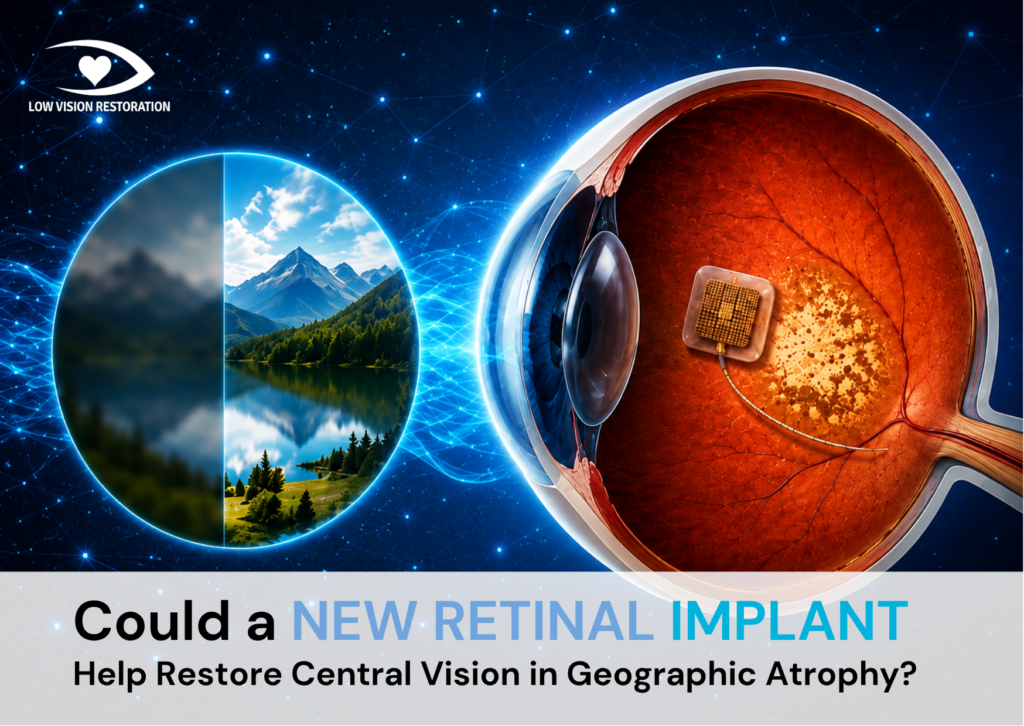
A very small photovoltaic implant is surgically placed underneath the retina in an area affected by geographic atrophy. The implant contains hundreds of tiny light-sensitive pixels.
The patient also wears specialized glasses equipped with a camera and projection system.
The glasses capture information from the person’s surroundings and convert that information into patterned near-infrared light. The system projects that light onto the implanted chip.
The photovoltaic implant converts the projected light into electrical stimulation, activating remaining retinal nerve cells. Those signals can then travel through the visual pathway toward the brain.
In simple terms, PRIMA is designed to provide an alternative way for visual information to reach the brain when the eye’s normal photoreceptors have been lost.
It is a remarkably different approach to severe central vision loss from geographic atrophy.
What Have Clinical Studies Shown?
This is where the PRIMA story becomes especially compelling.
The pivotal PRIMAvera clinical study included 38 people with severe central vision loss caused by geographic atrophy associated with dry AMD. Of the 32 participants who completed the 12-month assessment, 26 (approximately 81%) experienced a clinically meaningful improvement in visual acuity with the PRIMA system.
The average improvement was approximately 25 letters on the ETDRS eye chart, with the best individual improvement reaching 59 letters.
The researchers also reported that many participants could use the artificial vision system for practical tasks. In the published study, 84% of participants reported using the system at home to read letters, numbers, or words.
Those are remarkable findings, particularly because the participants had profound central vision loss.
But there is an important distinction.
PRIMA does not simply restore normal eyesight.
The system provides a form of artificial or prosthetic vision, and the visual information it creates is different from natural vision. Patients need to learn how to use and interpret that information.
That distinction matters.
PRIMA Is Designed for a Very Specific Type of Vision Loss
It would be easy to read about PRIMA and think, “Could this restore my vision?”
The answer is not necessarily.
PRIMA is designed for a very specific patient population, particularly people with severe central vision loss from advanced geographic atrophy in dry AMD.
Many people with low vision have useful remaining vision. They may have difficulty reading, driving, recognizing faces, working, cooking, using technology, or navigating their environment, but their level and pattern of vision loss may differ greatly from the people included in the PRIMA clinical studies.
This is one reason comprehensive low vision care remains important.
A person does not need to wait for a retinal implant to explore ways to make better use of their remaining vision.
Magnification, specialized low vision glasses, electronic devices, improved lighting, contrast strategies, accessibility features, and rehabilitation can all play important roles depending on a person’s visual needs and goals.
What Makes PRIMA So Interesting?
One thing I find particularly interesting about PRIMA is the technology’s potential to evolve.
The current implant uses 378 photovoltaic pixels, each approximately 100 micrometers in size. That resolution limits the detail the artificial visual system can initially provide.
Researchers are already exploring what could happen with smaller pixels and higher-resolution implants.
This matters because visual detail matters.
Detecting light or recognizing a large object is very different from distinguishing small letters, facial features, or other fine details.
Research published in Nature Communications has explored the potential of next-generation implants with smaller pixels, suggesting that increased resolution could eventually improve the acuity achievable with photovoltaic retinal implants.
That is one area I will be watching closely.
Could future generations of retinal implants provide more detailed artificial vision?
Could improved image processing make the information more intuitive?
Could these technologies eventually help a broader range of retinal diseases?
We don’t have all those answers yet.
But the questions are exciting.
The Brain Has to Learn a New Kind of Vision
Another important part of the PRIMA story is rehabilitation.
Restoring visual input is not necessarily the same thing as restoring familiar, natural vision.
The brain has spent a lifetime interpreting visual information in a particular way. With a retinal prosthesis, the information arriving through the visual system is different.
Patients therefore need time and practice to learn how to interpret and use the visual information generated by the system.
That is one reason the rehabilitation component is so important.
It also reinforces something I see regularly in low vision care: vision is not just about the eyes.
The brain plays an essential role in interpreting what we see.
Whether someone is using a magnifier, electronic device, specialized glasses, or an emerging retinal technology, learning how to use the available visual information effectively can make a tremendous difference.
Is PRIMA Available Today?
This is an important question, especially because information about PRIMA has changed rapidly.
In July 2026, PRIMA received European regulatory approval, allowing commercial availability in Europe for its approved use in people with geographic atrophy caused by dry AMD.
The situation is different in the United States.
PRIMA received FDA Breakthrough Device designation in 2023, but Breakthrough Device designation is not the same thing as FDA marketing approval. Science Corporation has been working with the FDA on the regulatory pathway for bringing PRIMA to U.S. patients.
So, for people in the United States, PRIMA is not currently something that can simply be prescribed as part of routine low vision care.
That may change as the regulatory process progresses.
And if it does, careful patient selection will still be essential.
What About Other Retinal Diseases?
Science Corporation is also investigating whether PRIMA could eventually have applications beyond geographic atrophy caused by dry AMD.
The company has described plans to investigate the technology in conditions including retinitis pigmentosa and Stargardt disease. These applications remain areas of clinical development rather than established treatments.
That distinction is important.
Clinical research can show what a technology may eventually do, but it does not mean every potential application is currently available or proven.
As with any emerging medical technology, we need to separate what has been demonstrated in clinical research from what researchers hope to accomplish in the future.
What Does PRIMA Mean for the Future of Low Vision Care?
For me, this is perhaps the most interesting part of the conversation.
Low vision care has traditionally focused on helping people adapt to permanent vision loss and make the most of the vision that remains.
That work is still incredibly important.
But we are also entering an era in which researchers are exploring ways to restore functional vision by working around damaged parts of the visual system.
PRIMA is an important example of that shift.
The technology does not make geographic atrophy disappear. It does not regenerate damaged photoreceptors. And it does not provide normal eyesight.
But the clinical results demonstrate that it may be possible to provide meaningful central visual information to people who have lost much of their central vision because of advanced geographic atrophy.
That is a significant development.
How Far Could Vision Restoration Technology Go?
I think that is the question worth watching.
We already have evidence that PRIMA can provide useful artificial central vision for some people with severe geographic atrophy. We now have longer-term clinical experience, published results, and European regulatory approval.
The next questions involve refinement.
Can the resolution improve?
Can the technology become easier to use?
Can rehabilitation help people become more efficient at interpreting the artificial visual information?
Can the system eventually be adapted for other retinal conditions?
And perhaps most importantly, can future generations of these technologies provide people with more useful vision for everyday life?
We do not know yet.
But we are closer to finding out than we were just a few years ago.
That is what makes this such an exciting development to follow.
What Should You Do If You Have Geographic Atrophy or Low Vision?
If you are living with geographic atrophy, dry AMD, or another condition causing vision loss, you do not have to wait for future technology before exploring ways to improve your day-to-day visual function.
A comprehensive low vision evaluation can help identify what may be possible with your current vision.
Depending on your needs, that may include specialized low vision glasses, magnification, electronic technology, lighting and contrast strategies, environmental modifications, and rehabilitation techniques designed around the activities that matter most to you.
Emerging technologies such as PRIMA may become an increasingly important part of the vision restoration conversation. But today, there are already practical ways to help people use their remaining vision more effectively and maintain independence.
If you have geographic atrophy or another condition causing low vision and would like to understand your options, we invite you to learn more about Low Vision Restoration.
There is life after vision loss, and there may be more possibilities than you realize.
Dr. Chris Palmer
There Is Life After Vision Loss
Low Vision Restoration