By Dr. Chris Palmer
Here’s something I want you to know, and it might surprise you. New research presented at this year’s Optometry’s Meeting found that the worse a person’s vision, the more likely they were to also show signs of cognitive decline. Researchers at the University of South Florida studied nearly 10,000 nursing home residents and found that, compared with residents with normal vision, the odds of cognitive impairment were 1.2 times higher with mild visual impairment, 1.5 times higher with moderate visual impairment, and 2.7 times higher among residents who were blind.
Full study summary: Cognitive loss in nursing homes more likely with visual impairment (Healio), https://www.healio.com/news/optometry/20260820/cognitive-loss-in-nursing-homes-more-likely-with-visual-impairment.
WHY THIS MATTERS TO ME, AND TO YOU
I have spent my career watching the relationship between vision and independence up close, so findings like these do not surprise me, but they do validate something I say often. Vision is not separate from the rest of a person’s health. When someone cannot read a medication label, recognize a familiar face, or follow a conversation across the room, the strain on memory, mood, and daily function adds up.
One of the researchers behind this study put it simply: many people in nursing homes and assisted living are not getting any eye care at all, let alone specialized low vision care. That gap worries me, because the people who often need help the most are the ones least likely to receive it.
THE MENTAL HEALTH PIECE WE CANNOT IGNORE
Vision loss and memory are not the only things connected here. The mental health impact of visual impairment is well documented. Research summarized by the National Council on Aging shows that adults with significant vision loss experience nearly double the rate of anxiety and depression compared to people with normal vision, often driven by a loss of independence, frustration, and isolation.
Reference: Supporting the Mental Health of People with Low Vision (NCOA), https://www.ncoa.org/article/mental-health-risk-and-vision-loss-how-to-help.
IT STARTS WITH USABLE VISION, NOT A CURE
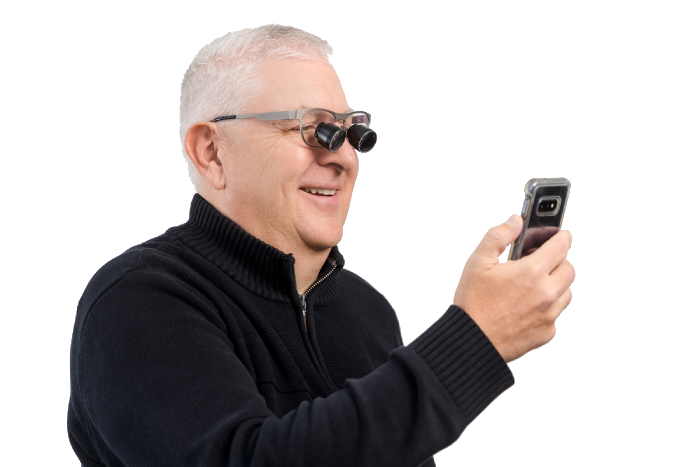
To be clear, low vision care will not reverse cognitive decline. What it can do is help someone make the very most of the vision they still have, whether that means recognizing a grandchild’s face, following a conversation by seeing lips and expressions more clearly, or finding their way safely around a familiar room. For a family member watching a loved one withdraw, that kind of support can matter enormously.
WHAT I WOULD TELL A FAMILY MEMBER TODAY
If you have a parent, spouse, or loved one in a care facility who has not had an eye exam in years, start there with their regular eye doctor. If vision has already been addressed and usable sight remains, a low vision evaluation may be the next step, built entirely around what still matters most to that person.
LET’S TALK ABOUT YOUR LOVED ONE
I offer a free low vision phone consultation to talk through your family member’s situation, no pressure, no obligation. There is life after vision loss, even later in life, and even in a care setting. Call me at 612-729-3030 and let’s talk about what is possible.